
Cassia Corapia & Daenerys Targaryen - Characters compared
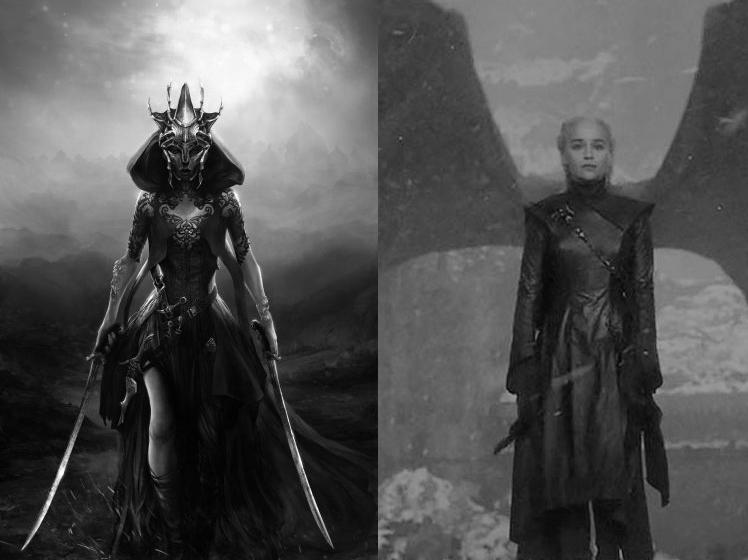
In this first article of our “Characters compared” series we analyse two female figures with several affinities: Cassia ‘Corapia’ and Daenerys Targaryen. Both set out with nothing beyond their name and their will; both headed down the long path toward the throne.
Protagonist of the video game ‘Blackguards 2’, Cassia of Tenos is a young woman of noble birth given in marriage to Marwan al-Ahmad. When he seizes power in the empire of Mengbilla, he orders his wife captured in her sleep and thrown into the labyrinth beneath the capital’s Arena. Cassia wakes suddenly a prisoner, with no apparent reason, and unaware of the fate of her beloved sister Mirai. With a jailer as her only human contact, she soon discovers she is not alone: the underground is infested with Corapie, great spiders held to be sacred. Their venom devours only one thing — body or spirit. The gods decide which. In one of her attempts to find a way out of the labyrinth she stumbles upon a book that will change her life completely: ‘The Good Ruler’. Rule number one: the good ruler loves everyone, trusts everyone, is everyone’s friend; their words serve everyone. Rule number two: the good ruler loves no one, trusts no one, is no one’s friend; their words serve only themselves. Having survived, she spends her days learning new stratagems and studying power, and her nights in constant search of an escape route. Her thoughts are drawn to the book like moths to a flame. Four years pass, and captivity and the spiders’ bites corrode her mind, leaving her a single desire: to reign over everything and everyone, were it only for a single day. At last she escapes her imprisonment with the sole conviction that her destiny is to ascend the throne. At her side only the Corapie — which stopped tormenting her long ago — become her sisters.
Thus is reborn Cassia Corapia, the Spider Queen.
First she seeks faithful servants, champions for her cause, and finds them among the champions of the Nine Hordes. Beyond champions she needs an army, so she feigns capture in order to be taken to the imperial prisons, where she manages to free the Silent Legion — an army of soldiers trained from childhood to feel no emotion and to serve only the ‘god of blood’ and the commander chosen from among them, bearing the title of Manticore. Cassia wins their loyalty when Tallmud, the current Manticore, recognises her as the chosen of the God of Blood. In her campaign of conquest, Cassia faces moral choices: keep prisoners alive, or kill them to send a message to her enemies? Poison the river supplying a city, or conduct a long siege? Her decisions seem dictated as much by lucid madness as by deep moral fibre. If your reign cannot be founded on love, then let it rest on fear — love is the strongest of bonds, but fear is quicker to create. Before she can assault the capital, Cassia must confront the Makers, powerful mages capable of creating monstrous creatures — the backbone of Marwan’s army — and try to control those creatures through melodies. Victorious, Cassia must decide whether to destroy those abominations or use them to her advantage. After a bloody battle against Marwan and his strongest monster, the Petrifier, Cassia manages to ascend the throne, obtaining what she always desired. That very night all the Legionaries die, poisoned, and the following morning a crowd — celebrating or furious — enters the throne room. There they find Cassia seated on the throne, dead. How she is remembered depends on the choices she made in her climb to power.
Daenerys of House Targaryen, “Stormborn”, the first of her name, queen of the Andals, the Rhoynar and the First Men, lady of the Seven Kingdoms, protector of the Realm, princess of Dragonstone, khaleesi of the Great Grass Sea, “the Unburnt”, “Mother of Dragons”, queen of Meereen, “Breaker of Chains” — as her full name goes — is one of the protagonists of ‘A Song of Ice and Fire’. She is taken into exile with her brother Viserys when Robert Baratheon wages war on her father, the king on the Iron Throne. Dragged by her brother around the Free Cities, she is then married off by him to Khal Drogo, chief of a Dothraki tribe, in exchange for his help in retaking the throne. Watching Viserys ‘crowned’ with molten gold before her — a victim of his own hunger for power — the young woman does not flinch, becoming herself the rightful heir to the Iron Throne. She follows her husband and the Horde across the great grass sea until, during an attack on a town of shepherds, she pleads mercy for some women, among them a priestess. When her husband is wounded in a fight she asks the priestess for help — but the woman deceives her, taking the life of the child in her womb and leaving the Khal alive yet in a vegetative state. A chief who cannot ride is no longer a chief, and his khalasar dissolves, leaving Daenerys alone with the few who remain loyal. Losing an army, a child and a husband, she nevertheless gains something more precious: stepping into the flames of the Khal’s funeral pyre together with three dragon eggs, she emerges unscathed, with three dragon hatchlings that will look to her as their mother.
For the first time in her life, Daenerys is mistress of her own destiny, with no one to command her.
She wanders the Red Waste and from there to Qarth, where the warlocks approach her with dark prophecies. She then travels to Astapor, the city of the Good Masters, where through a clever deception she gains control of an elite army of slaves, the Unsullied. Here she meets Missandei, who will become her adviser and friend. Seeing the conditions in which the slaves live, she also finds a purpose: to break the chains of every slave in Essos. With a swift military campaign she subdues Yunkai and Meereen as well, the latter becoming the capital of her new realm. After the conquest, however, she must govern the city, and there her ideals are put to the test. Faced with intrigues and the compromises of politics, the young queen makes decisions that earn her as many allies as enemies. In the books the story stops here, while in the TV series we see Daenerys cross the narrow sea, ready to claim the Throne. She nevertheless decides to help the Starks and the North in the war against the White Walkers. She reaches King’s Landing with only one dragon left, having watched many people she cared for die. When her victory is all but certain, a mad rage overtakes her and she begins to set the city ablaze from the back of her dragon, sweeping streets and buildings with fire, burning the entire population, women and children included. Queen of a city reduced to ashes, she will only brush against the throne before one final betrayal — driven by the desire to stop her madness — costs her her life.
SIMILARITIES
Both share the experience of a forced marriage, an event that marks them and forms the first step in their long climb to power. Both know betrayal, which strips them of everything, leaving them alone and defeated. Yet both rise again, more determined than before. Both are ‘mothers’ — not of children of their own, but of creatures that become like children to them. Daenerys’s dragons are the symbol of her house as well as her greatest resource and weapon of war. As they grow, though, they become hard to manage — so much so that for a time she must even imprison them, before regaining control. For Cassia the relationship is different: the spiders, once her tormentors, later became her companions, as if recognising her as one of their own, with no apparent logic. They follow and protect her, but obey her in no way. Their bond seems almost symbiotic. Both seek champions, advisers and guides to help them along their path, to make up for their inexperience and protect them. These are not good people, but controversial figures — capable, yet of questionable morals. At Cassia’s side stand the dwarf Naurim, a skilled but miserly banker; the gladiator Takate, interested only in a legendary death; and the mage Zurbaran, whose mind is clouded by drugs and remorse. Beside Daenerys stand Missandei, a young slave raised to be a translator; Ser Jorah Mormont, an exiled knight with a murky past; and Daario Naharis, a flamboyant, passionate mercenary. Both gain control of an utterly loyal army. Daenerys wins the loyalty of the Unsullied, eunuch slaves trained as warriors from childhood, to whom she grants freedom; Cassia frees the Silent Legion from the prisons where they were confined, and this mercenary army chooses to follow her upon seeing in her the chosen of the God of Blood, the deity of battle they worship. Both brought great changes to their world, but did not live to see them — leaving an ambiguous legacy, split between those who loved them and those who hated them.
DIFFERENCES
Among the differences we find appearance. Daenerys is renowned for her beauty and exploits it on several occasions for her ends. Cassia, disfigured by the spiders’ venom, wears a mask and heavy garments, feared and regarded almost as a monster. She too exploits her appearance — to intimidate her adversaries. Their path — or rather, the path of their madness — is antithetical. Cassia appears from the start devoured by madness, consumed by her obsession and mentally unstable. She often talks to herself, or follows lines of reasoning whose meaning only she knows. And yet, despite this, she achieves solid results, and as time passes it becomes ever clearer that there is method in her madness — enough to make you doubt whether she is truly mad. Daenerys begins as a naive girl and learns through life’s hard lessons. She shows, however, a very strong moral fibre; even when she must order massacres, as with the slavers of Yunkai, she is never cruel. On many occasions her goodness is questioned, and yet she keeps her integrity. In the final season of the TV series, instead, the character changes with breathtaking speed: the cruel nature of the Targaryens surfaces, up to the indiscriminate massacre of the population of King’s Landing despite the city’s surrender. Her final speech — the will not to stop at the throne, but to bring ‘peace’ to the world — is proof of a total transformation, in which the end justifies every means.
Do you agree with our analysis? Have you noticed other ways these two great female characters could be compared? Tell us what you think in the comments!