
How to handle clues in roleplaying games?
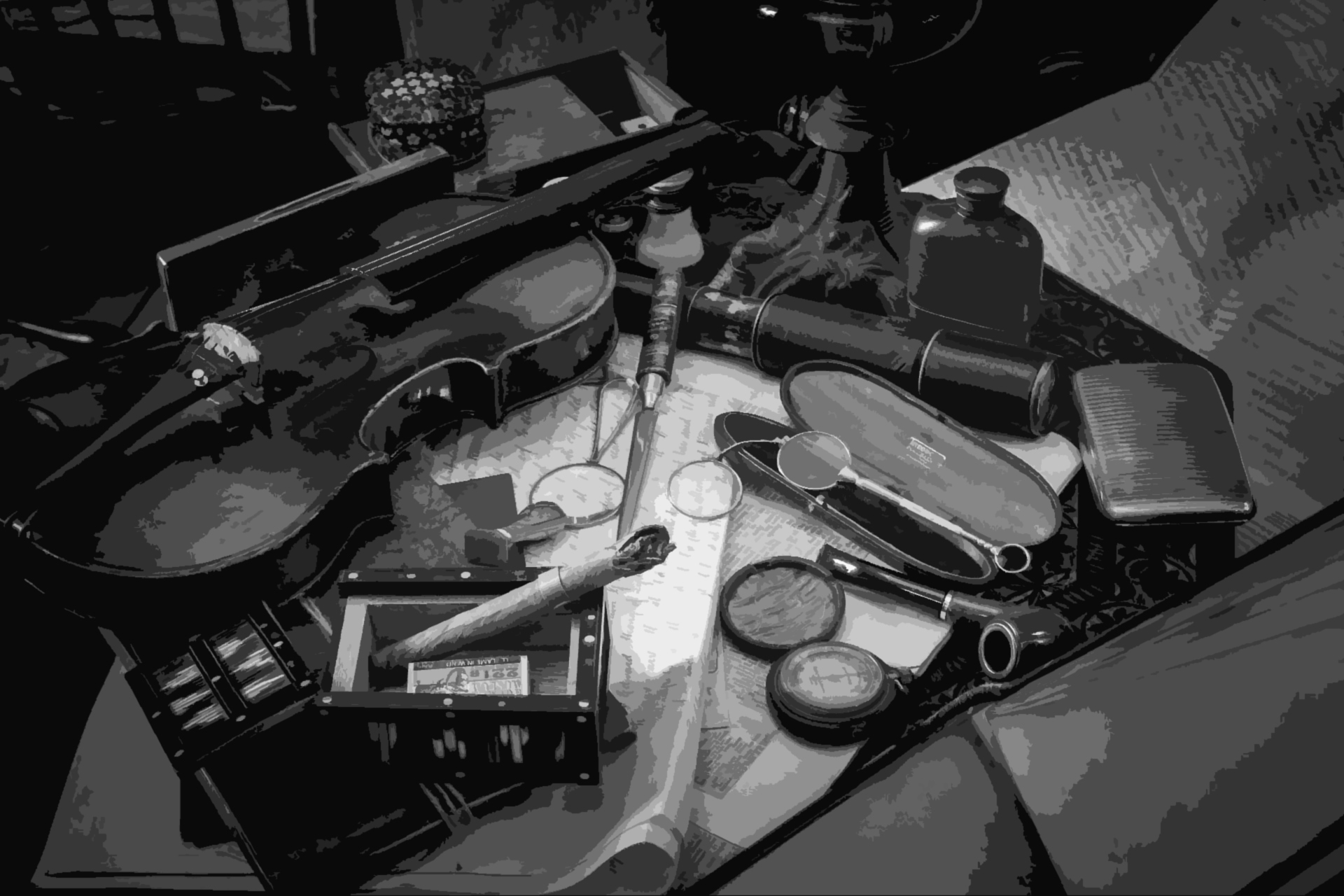
For our column dedicated to game masters, we tackle the topic of handling clues in roleplaying games.
What is a clue?
A sign — abstract or concrete — whose presence can indicate the existence of something else; an established fact that allows another fact, not yet occurred or not directly known, to be predicted or deduced with some grounds.
What is a clue for?
Clues allow the master to guide the players through the adventure and move the plot forward. They also let players interact immersively with the elements of their adventure’s setting. These elements are information the players might not normally have access to, since they portray characters with a limited set of knowledge. In some games, gathering and understanding clues is the very heart of play.
This guide is designed especially for that kind of game, but it applies to any game. Not just investigative and horror games: fantasy and science fiction also often feature sessions in which players must deal with clues. Knowing the colour of the dragon you are about to face, or the true nature of the mysterious bandit terrorising the region, are good examples of why clues matter.
There are three kinds of clues: main, secondary, and false.
-
Main clues are those that serve the progress of the plot. Some are keys to unveiling the background of mysterious situations of great consequence for the story’s central people and events. For this reason they demand the players’ utmost attention to be understood. A main clue that is unreachable or contradictory can derail the entire plot, putting the master in serious trouble and forcing improvisation. Improvisation skills are always important — but introducing an unplanned NPC is one thing; piecing together all the elements of a complicated murder in a few minutes is quite another!
-
Secondary clues are elements that enrich the play experience, stimulating the players’ creativity in solving interesting ‘cases’ that may connect to further main clues. These clues are relevant to the plot but not decisive for the investigation. They can be tied to ‘rewards’ — a loaded revolver, say, or information on the true nature of an antagonist the group is about to face. They must not be rewards essential to resolving the plot, but they can simplify certain tests and give players a sense of satisfaction. If the enemy can only be killed with silver bullets, that is a main clue; if silver weakens it but it can be killed in other ways, that is a good secondary clue.
-
False clues serve to steer players away from solving the mysteries the master has devised. In some cases, though, they are also random elements ‘scattered’ by non-player characters, or caused by events beyond the players’ control: it is up to the players to decide whether they matter to the plot or are just meaningless environmental signs. Is the wet stain on the floor a detail the master described to draw attention away from the bookcase, or the killer’s attempt to wash away blood? Or could it simply be a pipe that happened to burst? We will see later how this type of clue is fundamental for pacing a good session.
Who is the clue for?
When you create a clue, ask yourself: who is the clue designed for? A single player or the whole group? Clues can be general — aimed at the whole group, like a bloodstain under a rug or noticing you are being watched from a window. These clues can be ‘picked up’ by any type of player, since characters need no specific abilities to become aware of them. A bloodstain on the edge of a painting, or footprints visible from the window, can be seen by any character, and it is statistically likely someone will find them. Personal clues are instead aimed at a character with specific abilities or knowledge — recognising a certain kind of plant, say, or being able to crack a safe.
Depending on the game, the master can favour one type of clue over the other. The first type is easier for the master to manage and for players to discover. The second — which at first glance seems to feed the group’s competitive spirit — when handled well increases interaction and sociability among the members, who are pushed to discover the information their companions hold. For personal clues we strongly recommend introducing multiple parallel routes to the same information. The safe in the victim’s study can be picked open, but also opened without damaging its contents by an explosives expert. If the players find an original but sensible way to use their abilities that you hadn’t thought of, go along with it!
How is the clue obtained?
There are permanent clues, like bloodstains at the crime scene; recurring ones, like being tailed by someone; and temporary ones, like footprints in the mud that will vanish with the first rain. Main clues had better belong to the first two categories, while secondary or false clues can also be of the third. You can reward players who catch recurring clues early with in-game advantages and extra information. Conversely, missing clues can be a little frustrating — but that’s part of the game! Don’t agonise over placing clues that can’t be obtained without giving up others. If they choose to chase a shady figure, they lose the chance to notice a particular perfume at the crime scene. Such choices make the players more involved and the plot less linear.
When to give the clues?
The master must account for the players’ fun and attention at the table. Handing out clues too early can make for a bland experience, while giving them too late can frustrate the players. Finding the right timing is essential. Here one could distinguish between mystery, investigative, police procedural, thriller and horror — but we will cover that more thoroughly in a future article. What you must keep in mind is the rhythm you want to give the session. Can the characters calmly gather the clues and piece them together, or is the antagonist actively working against them? Are the gathered elements decisive, or mere preparation for a final showdown full of gunfire? False clues are a particularly useful tool for raising the tension at the table. Did the back door slam because of the storm, or did someone just flee? Is that unsettling doll resting on the stairs a simple toy, or the heart of the curse? Has that moose head mounted as a trophy always been there — does it perhaps hide a camera that filmed everything, or is it possessed by a Kandaharian demon?
Types of clues.
There are various types of clues, for instance: simple clues, multiple clues, composite clues and long-term clues.
Simple clues are the most used. Players may find them or not, understand them or not. Whether dice are rolled to discover them or they are handled purely through roleplay, in general you either get them or you don’t.
Multiple clues occur when a single clue can yield several pieces of information. The footprints under the window primarily show where the killer came from but, secondarily, a keener observer might also deduce the suspect’s height and weight. These clues can thus be read on several levels, depending on the test result or on how the players interpret them.
Composite clues must instead be gathered together before the information can be extracted. The players found a pile of newspaper clippings, but they could spend days reading them all without noticing anything relevant. When they find a date written on the back of a painting, they will immediately find the article that leads them toward the solution of the mystery. If it is a main clue, the master should make clear to the players that something is missing; if it is secondary, everything can be left in the players’ hands!
Long-term clues are similar to composite ones, but require a precise trigger — not immediately accessible — to be understood. The players found a handkerchief with initials on it, but only when they see the policeman with a lighter bearing the same initials will they grasp the connection. Other examples: the results of laboratory analyses the characters requested, or the reply letter from an expert in ancient artefacts. This type is very useful for turning events around, and lets the master decide at which point of the session the players can advance, bringing certain events forward or pushing them back as needed.
Improvising clues.
As mentioned earlier: if writing a detective story is hard, imagine writing one where the characters do as they please and (often) have terrible ideas! If your players miss a main clue you had carefully prepared, don’t improvise on gut feeling! Take a few minutes to review your material. Can you re-present it differently, or later? Can you replace it with another? If the answer is yes, carry on with confidence: their car engine might refuse to start, a telephone might ring in the murder room drawing them back inside, or a strange vagrant might approach, shouting about the coming of the “King in Yellow”!
If instead you can’t untangle the knot, we advise speaking plainly to the players. Explain that you had a different situation in mind and ask them to meet you halfway. Avoid telling them what their characters should do — address the players. This may break immersion a little, but sometimes it beats sliding into a muddled plot that will crumble beneath your feet.
Clues in one-shots and campaigns.
Most investigative sessions are one-shots, or limited to a few meetings. In that case, sketching out the investigation and its clues is relatively easy. If the game is also horror, reaching an ending — however disastrous — is easy. They didn’t figure out how to disperse the invocation of Haspur? They didn’t realise the museum caretaker is an Enigmanthrope? They got lost eating kibble in the bipeds’ pantry? If instead you are playing a campaign, things get complicated. Our advice is to build narrative arcs, with a few clues belonging to the backbone plot and many others that lose importance at the end of each arc. Running an original investigative campaign is a demanding feat. If you can, first play through a campaign like ‘The Lord of Lies’ or ‘The Masks of Nyarlathotep’ to cut your teeth!
Clues, in-game and off-game.
To conclude, let’s talk about the difference between in-game and off-game clues. The residue of a substance on a glass is a clue that only the characters can analyse and resolve. Clues hidden in a newspaper headline or a coded message, on the other hand, can be prepared and handed to the players, who will solve them in person. This kind of clue is usually much appreciated and repays the master’s efforts. It can become a double-edged sword, though, if not handled well. You have several people at the table: it is usually hard for more than two or three to collaborate on a single clue. You risk ending up with a few players actively solving it while the others watch, bored. One way to avoid this is to arrange things so that, in-game, while some characters are busy solving the puzzle, the others must act. Solving riddles is fun — less so if cultists armed with shotguns are trying to ‘distract’ you and no one is holding them off.
Another way is to create clues that can be solved in small groups. In any case, try to give players time limits for analysing these clues, especially in a one-shot — or you might spend the whole evening trying to decode a Vigenère or a Caesar cipher.
Bonus: adventures with intended final failure.
There are games in which the failure of the investigation is not only possible but inevitable. In these games the goal is not to solve the case, but to live the investigation and the characters’ evolution. We are talking in particular about Gumshoe (Trail of Cthulhu, Fear Itself, The Esoterrorists, etc.). Here the characters obtain the clues with certainty, but the clues are filtered through their abilities and personalities. A priest with expertise in art will notice that the subject of the painting is rendered with a very strange technique and suspect demonic inspiration; a chemistry professor will notice that the canvas looks far older than it should be, and wonder which substances might have caused the ageing.
In this case every clue has several possible readings, and different characters will form different ideas about what is happening — even clashing over how to act. Everyone has understood that the sinister clown is not human and lives in the sewers. Is it better to run, call the police, or arm yourselves with a slingshot, silver earrings and courage to face it?
And so we close this tour through the theme of clues in RPGs. What do you think of our arguments? Would you add anything? Write to us in the comments here or on our Facebook page!