
Introduction to 3:16 - Carnage Amongst the Stars
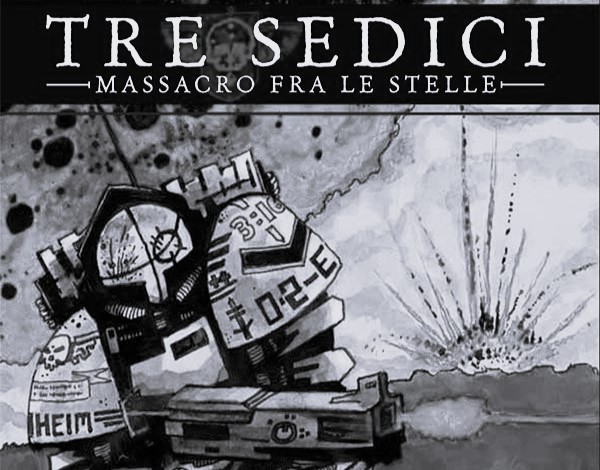
Ready to begin an action-packed adventure in space? Get into the right mood with this introductory guide to the roleplaying game 3:16 - Carnage Amongst the Stars!
A platoon of soldiers of the XVI brigade of the III army ventures into an inhospitable desert on a distant planet, codenamed Klimt, in search of missing comrades. The orders are clear; the mission’s success is non-negotiable.
Klimt is a rain-lashed planet whose atmosphere is highly charged with electricity. Storms can throw communications between units on the surface into chaos and make contact with the ships in orbit difficult.
From the moment we land, ten kilometres from the base that sent the last signs of life, we — Sergeant Majers, Corporal Rocky and the three privates Jimmy, Redstone and John, members of the platoon — are engulfed by the fury of a violent storm. Armed to the teeth and equipped with the MandelBrite armour that lets us survive in an alien environment, we press on toward the base following the few directions available.
A few kilometres in, the Sergeant hears a sudden “click”. Too late we realise we have wandered into a minefield, and that one of us has stepped on a mine. Embarrassed and panicking, Sergeant Majers begs us to save him, fearing the worst — but Jimmy’s idea of help is to resolve the impasse by detonating the mine.
The Sergeant curses and writhes; his limbs bear several wounds, but he is more than determined to keep giving orders. We administer first aid on the spot and realise we are in a very awkward position, with a wounded man to carry. Nevertheless we decide, with supreme nonchalance, to continue along the mined path, thoroughly strafing the ground from a safe distance before stepping on it, to set off the mines.
Reaching a radio relay station, we find the place abandoned and sealed, with no trace of the survivors we are looking for. Shortly after, from a rise, aliens appear — the size of medium dogs, made of metal, with two forelegs and a long body ending in a tail, their muzzles made of circular blades. A no-quarter firefight begins. We work our rifles, screaming, careless of the rounds spent, while Corporal Rocky charges the energy cannon and fires at the rise. The fight is hard; private Redstone dies, but the enemy is overwhelmed and exterminated.
The mission continues, and after an hour’s march we reach the base that sent the last S.O.S. We find the corpses of several soldiers, while the storm keeps raging and limits our communications. Without bothering to have a plan, though well aware of possible threats, we enter the facility by blasting one of the half-open gates with cannon fire. More bodies and human remains are scattered across the great hall before us, which we begin to cross in the half-dark. Suddenly we hear moans: a soldier is still alive. We rush to him and ask what happened, but after a few syllables he dies in our arms. We barely have time to gather the bodies of the fallen before “something” in the shadows lunges at us.
Mindful of the previous fight, we react promptly — and with perhaps excessive harshness. We maul several alien creatures that had crept up behind us, similar in appearance to the fallen soldiers but with a suspicious gait and clearly makeshift armour. We brace for battle with the ones surrounding the facility, whose horrifying cries we can hear.
Before going out, we hastily ask ourselves: how do we stop more monsters from climbing out of the well in the middle of the hall, given that we have neither means nor time to seal it? The Sergeant is still lucid, and has the solution in his pocket. His imperative: throw a grenade down the well to slow any threats. He doesn’t hesitate — he does it himself. Lady Luck looks the other way. The throw is so crooked that it includes a bounce off the rim of the well. The grenade comes back at us and explodes, riddling us with wounds.
Those of us who can still move drag the comrades still alive — the Sergeant among them — while shooting, shooting and shooting again, boldly exiting the facility. The enemies try to overwhelm us by sheer numbers. Only three of us make it out — Sergeant Majers, Corporal Rocky and private Jimmy — retracing our path back to the shuttle.
Chased by enemies, tired and frightened, we make mistakes. Just before we can pull it off, a quarrel breaks out between the Sergeant and Jimmy — the one who had wounded him at the start — now determined to get rid of him. He succeeds, only to be killed in turn by Corporal Rocky and his cannon. Rocky is the mission’s sole survivor, and receives a promotion from military command for discovering the fate of the soldiers stationed on that planet — and in memory of the valour of his ‘lamented’ fallen comrades.
The game
Now that this tale of our introductory session has put us in the right mood, we can dig into the features of 3:16, designed by Gregor Hutton for Coyote Press.
The nearly 200 pages of the 3:16 manual focus on how to build alien worlds, how to crush the Xeno Horde, and how to rise through the ranks. Players must prepare to face hordes of Aliens in vastly superior numbers and slaughter as many as possible. RPG veterans, science-fiction lovers and the imaginative will easily find hooks for their sessions — though it is best to avoid the classic sci-fi film plots where aliens simply want to kill Humans, to guarantee more fun at the table.
The rules
The rulebook is divided into two parts.
-
The first part describes character creation.
-
The second part is for the Game Master.
Reading it makes clear that the goal of the game is not only to kill the highest number of aliens, but also to help players create deeply introspective characters. To that end, a simple rule introduces Flashbacks. A Flashback, besides granting a positive turnaround in a bad situation, projects the character into a past moment of their life — a moment akin to what they are living in the present. The character sheet is very lean and can be filled in within minutes.
The manual’s ease of use and the immediacy of the rules are a double-edged sword. On one hand they favour group imagination and storytelling in creating monsters and new worlds from scratch; on the other, the Game Master is left with too little detail to structure deeper sessions, which would demand a serious world-building effort. There are several tables for ‘generating’ the outline of an adventure, but much is left to the Game Master.
In combat, the die roll for using a weapon does not indicate damage dealt, but directly the number of enemies killed. The kill count determines promotion through the ranks.
Conclusion
3:16 is an introspective game of space guerrilla warfare that can adapt to the needs of the narrator and the play group. The atmosphere can be grim, insane, horrific, or humorous and tragicomic, according to taste. We recommend it to anyone who wants to try new games even over a few sessions, or through a mini-campaign that can prove rewarding if you love the genre. It lends itself well to adrenaline-fuelled one-shots, with time to explore the introspective side of the characters — who are not just killing machines, but humans.