
Introduction to Delta Green
Deception is a right. Truth is a privilege. Innocence is a luxury.
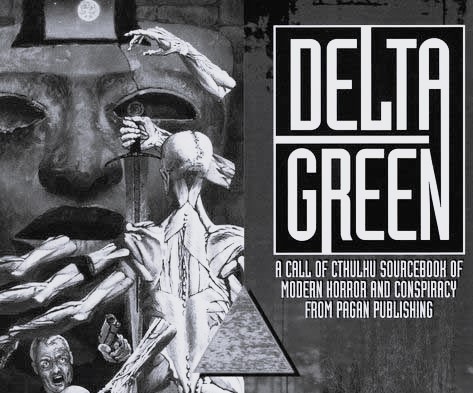
Born from the United States government’s 1928 raid on the degenerate coastal town of Innsmouth, Massachusetts, the secret agency known as Delta Green opposes the forces of darkness with honour, but without glory. Delta Green agents slip through the system, manipulating the federal bureaucracy while they push the darkness back for one more day, sacrificing themselves. Delta Green is a setting for the roleplaying game ‘Call of Cthulhu’, written by Adam Scott Glancy, Dennis Detwiller and John Tynes — also known as the Delta Green Partnership — of Seattle publisher Pagan Publishing. Born as a supplement for Call of Cthulhu, it later became a standalone publication. The latest edition dates to 2018, published by Arc Dream Publishing.
At the 2018 ENnie Awards, Delta Green took no fewer than six prizes: first place for Best Rules, Best Production Values and Best Electronic Book for the campaign A Night at the Opera, plus second place for Product of the Year and Best Game, as well as second place for Best Adventure with A Night at the Opera.
Setting
The inspiration for this setting comes from Howard Phillips Lovecraft’s “The Shadow over Innsmouth”, in which the federal government discovers and uproots an outpost of Deep One worshippers. An agency is then founded — Delta Green — to monitor unnatural entities and hide them from the public. Notably, in this game the whole matter of the Mythos is reframed in scientific rather than occult terms, much as in ‘The Laundry’.
Set in the mid-1990s, the game revolves around a fictional organisation called Delta Green.
Delta Green’s members are devoted to fighting the horrors of the Cthulhu Mythos. Recruited from US government agencies — the FBI, ATF, CDC, DEA and so on — Delta Green members operate in secret from their ‘daytime’ identities, finding themselves double agents with double lives. Unlike other ‘Cthulhu’ games, here the players take the role of agents with specific resources and skills for facing the Mythos, giving the adventures an innovative perspective. To complicate everything, between the ’60s and the ’80s the agency vanished, after a disastrous operation in Cambodia during the Vietnam War that also involved Majestic-12 and the mysterious faction of the Greys. The nod to The X-Files is unmistakable, even though the first version of Delta Green predates by a year the cult series it might seem inspired by.
System
The game system is Call of Cthulhu’s ‘Basic Role-Playing’, so percentile dice resolve the outcome of actions. However, a roll is made only when the outcome is uncertain; often a given score is enough to succeed at an action. Substantial changes were made to the Sanity system, reflecting the fact that those facing the Mythos are not oblivious civilians but trained agents, who grow accustomed to the horrors they witness and become more resilient to madness. The system of Bonds and Motivations also gives the character depth, justifying why they put themselves in extreme danger and confront the Mythos for the good of humanity. Since Sanity is eroded both by horrors witnessed and by deeds committed, characters must try to limit violence when it is not necessary.
The combat system was modified too. To increase realism, a lethality rating was introduced. Instead of rolling dice for damage, there is a percentage value: roll under it and the target simply dies; otherwise the dice are summed, often producing damage that is lethal to a human anyway. This makes fights far more adrenaline-fuelled and short — a brief shootout is often enough to end a confrontation without breaking the narrative rhythm. Healing, too, is slow and realistic, making choices like jumping out of a window or running down the stairs while shooting weigh much more heavily.
The Game
Players take on the roles of government agents, or expert contractors, who can draw — carefully — on the resources of their agencies as well as those of Delta Green. Very often, though, the missions will not be about investigating and uncovering mysteries but the opposite: burying cases and hiding information, covering up the existence of the Mythos. Moving at the edge of legality, and often beyond it, exploiting bureaucracy and the system, the agents will face difficult choices — all for the good of the world. The difficulty of acting without leaving traces, combined with the need to tap resources to complete their missions, demands great care and contributes to the wearing down of the characters’ psyche.
Delta Green supplements lay the foundations of the scenario, providing an initial plot and giving players the motivations and resources to complete their tasks. They also provide a source of replacements for characters who go mad, are killed, or decide to retire from service.
A second version of the game — or rather a prequel — titled ‘The Fall of DELTA GREEN’ came out in 2018, using Pelgrane Press’s ‘Gumshoe System’. It is set in the 1960s and covers the years that led to Delta Green’s ‘shutdown’ in 1970.
