Introduction to Shadow of the Demon Lord
Would you like to venture into a world on the brink of annihilation, torn apart by war, plague and ancient horrors?
Urth, the world of Shadow of the Demon Lord, holds everything you need for unforgettable emotions under the banner of fantasy. You can create characters to face the hordes of demons pouring out of the Void, and try to find your way through situations steeped in horror and violence.
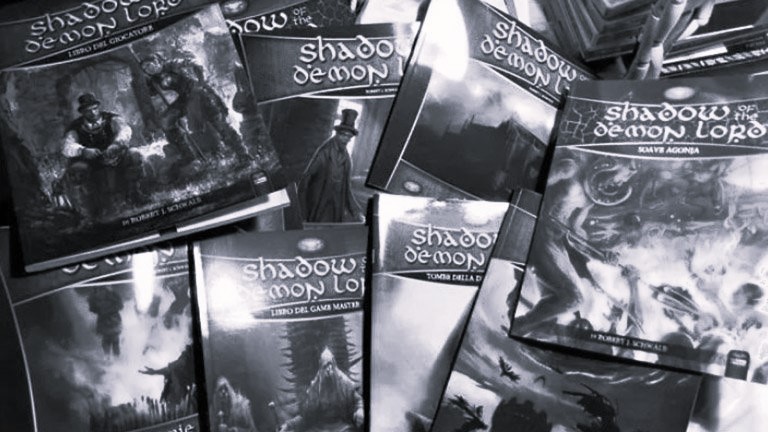
Shadow of the Demon Lord is a horror-fantasy roleplaying game created by Robert J. Schwalb. It was funded through a Kickstarter campaign launched on 12 March 2015. The Italian version is published by Wyrd Edizioni. We too backed the Kickstarter of the Italian version, and so obtained our copy of the player’s manual and other accessories.

Setting
The game takes place on Urth, a world on the edge of the apocalypse. The cause is the Demon Lord, an evil entity with an ever-growing hunger for power, whose touch envelops and corrupts all existing things. The game offers several templates you can use to shape the way the world is collapsing. These templates represent the Shadow of the Demon Lord: wherever the Shadow falls, chaos and upheaval are born. The Shadow might unleash global pandemics, famines, droughts, earthquakes, the living dead and much more. The Demon Lord is an abstract, distant threat, whose effects on the world are ever-present, ranging from cataclysms to the appearance of Demons and the spread of Corruption. The adventures focus in particular on the continent of Rul. Here the Empire of Caecras, after 888 years of dominion, collapses with the death of the Emperor, killed during the Orc uprising. The orcs were slaves, created by humans through magic and science by mutating the giant-blooded taken prisoner in the long wars of the frozen south. Deprived of central control, the Empire crumbles into fiefdoms and city-states, while in the Northern Reach the border cities still try to stem the plague of undead descending from the Desolation. To the west, in the Endless Steppe, the centaur tribes keep their independence, and from the Auroral and Nyxian Oceans monsters and aquatic civilisations begin to scourge the coasts. New religions and old cults spring up everywhere as people seek salvation in such disastrous times.
To face this threat, the faerie have begun to leave their exile and fight the growing darkness. North of the Northern Reach lies the Desolation, a place overshadowed by dark magic and infested with the undead. Even the devils — dwellers of Hell, where they torture and torment souls stained by corruption — begin to take the field against the darkness of the Demon Lord, the common enemy.
Game mechanics
Shadow of the Demon Lord is played with two kinds of dice: a d20 and d6s.
For every positive circumstance that might help the player succeed, they gain a boon.
For every negative circumstance that might prevent their success, they suffer a bane.
The player chooses the character’s Paths (classes) three times, and the choices stack:
1. at character creation (novice);
2. at level 3 (expert);
3. at level 7 (master).
This allows the creation of multifaceted characters through a huge number of combinations, without having to pick a class at every level-up. Powerplaying is curbed and characters are far better balanced, without limiting freedom of choice and customisation. Also commendable is the balance between magical and non-magical classes, an issue often present in fantasy RPGs.
During character creation, the manual provides tables that — through random dice rolls — let you obtain a randomly generated character. This is a great option for those who want to try characters different from their usual, overcome indecision, or generate characters ‘on the fly’.
Tests are made by rolling a d20, adding or subtracting a number of d6s according to boons or banes. The test is passed with a result greater than or equal to 10, or to threshold values (armour, opposed tests, and so on).
The system gives characters ‘skill packages’ that favour certain actions, based on their profession. If the action requires knowledge covered by the profession, it automatically succeeds. If the action is in doubt, they get a ‘boon’ die. For example, if you play a sailor tying a knot in ‘normal’ circumstances, you succeed automatically; if you must tie it while being peppered with arrows, you get a ‘boon’ die for the action.
Levelling up happens only as a group: the actions of individual characters can speed up or slow down the growth of the whole party. This rule can strengthen the cohesion of a motivated group, or create internal friction where opinions and play styles diverge widely.
The bestiary available to the Master — counting the various modules and expansions — is enormous and highly varied. It ranges from the most classic fantasy RPG monsters to rarer beings, reaching ‘alien’ or science-fiction creatures.
Moreover, the way monsters are handled allows a ‘modularity’ that makes it extremely easy to modify or invent new ones, aiding improvisation and the needs of the story. Magic is divided into Traditions and Ranks: as they level up, characters can choose to learn spells from many Traditions (similar to D&D’s classic schools) or rise in rank within a Tradition they already know, gaining access to more powerful spells. Some Traditions, though, are dark: learning and progressing in them increases Corruption, even though they are usually powerful.
Madness and corruption
All mortal souls, at the moment of death, descend into the Underworld, where memories and identity fade until, once cleansed, they rise to reincarnate. Souls stained by corruption instead descend into Hell, where the Devils — dark faerie — torture the soul until its sins are erased.
Shadow of the Demon Lord is an amoral game. There is no good or evil. Players may portray their characters in whatever way makes sense for their individual stories. But some actions have lasting consequences. Murdering in cold blood, torturing an innocent, or learning Black Magic or Demonology spells can leave stains on the character’s soul. Corruption is a control mechanism meant to rein in these excesses. Accumulating corruption points triggers interesting developments, especially under the Shadow of the Demon Lord.
Example: if a character learns too many Black Magic spells, they may become so corrupted that once a week a child within 8 miles of them will die.
Another interesting mechanic is madness. Usually marginal in fantasy games, in SotDL the PCs’ sanity is continually put to the test. Characters can go mad when they see or experience something that harms them in a way that is hard to accept, physically or mentally — returning from death, a serious wound, witnessing the brutal death of a loved one, or fleshy monstrosities covered in slime with drooling maws. Rushing headlong into an unknown situation can have dire consequences for a character’s safety. Recovering from Madness is a long process, and together with Corruption it acts as a natural brake on recklessly extreme behaviour.