Introduction to Sine Requie
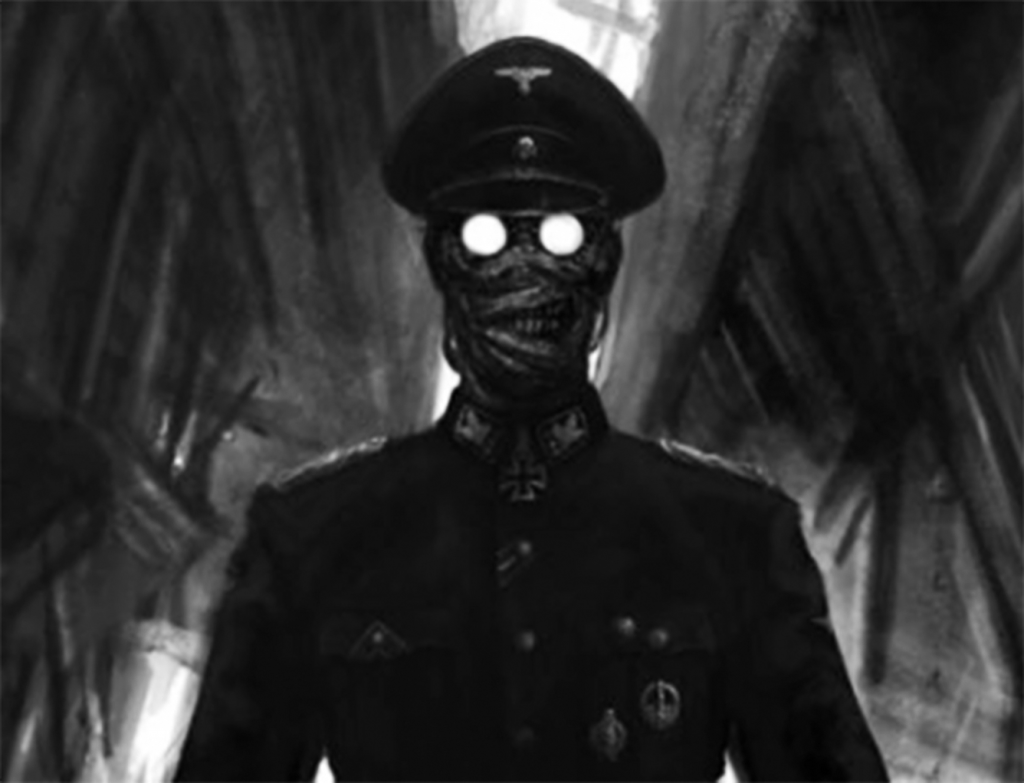
On June 6th, 1944, the world sank into the darkest of hells: on Judgement Day the Dead began their hunt against humankind. It is now 1957. The world has become a heap of rubble, where the few survivors try to resist the hunger of the Dead. A handful of nations, ruled by cruel dictatorships, withstand the siege of the corpses. In Germany the IV Reich has risen — a kingdom of horror and madness, of cold genetic experiments aimed at creating the chosen race. Great Russia lies buried beneath the titanic metal cities of the Soviet, governed by the inhuman computer called Z.A.R. Italy, renamed Sanctum Imperium, is ruled by Pope Leo XIV and his Inquisitors. This is the world of Sine Requie. The darkest future man could imagine has become the most monstrous of realities.
Sine Requie is an Italian horror roleplaying game, written by Matteo Cortini and Leonardo Moretti and first published in 2003 by Rose & Poison. The second edition, produced by Asterion Press, took the name Sine Requie Anno XIII. With this game a nightmare reality takes shape — destruction and madness, with humanity crushed between the insatiable hunger of the Dead and the horrors of the most terrible dictatorships. The latest version of the game is Sine Requie Anno XIII - Second Edition, produced by Serpentarium.
Awards
Winner of the Best of Show at Lucca Comics and Games 2003 as Best Italian Game, it stands out for using tarot cards instead of dice to resolve actions. A second, hardcover edition titled Sine Requie Anno XIII was published in 2007 by Asterion Press, winning the Best of Show as Best Roleplaying Game and the GMM Award, again as Best Roleplaying Game, in 2008. The first module for Anno XIII, Sanctum Imperium Anno XIII, won the Side Award at Lucca Comics and Games 2008 for “Best artistic profile”. During the 2013 edition of Lucca Comics and Games, a celebratory exhibition marked the game’s tenth anniversary, followed by a limited edition of the core rulebook.
Game mechanics
Unlike most RPGs, Sine Requie uses tarot cards to judge the outcome of an action or of peculiar situations. The minor arcana are used for numerical tests: the value of the drawn card must be lower than the tested skill for a success. The major arcana instead resolve the outcome of a whole scene, without testing individual actions. Alongside the rulebooks you can buy the Tarots of Judgement — 22 Major Arcana and 56 Minor Arcana — useful in play to master and players alike.
Setting
How did the world of Sine Requie begin?
The game is set in an alternate 1957. The world is not as we know it. History took another course. D-Day, June 6th 1944, is remembered as “Judgement Day”: the day the dead began to awaken, for unknown reasons.
Whoever dies, from any cause, rises again as undead. Some undead are slow and stupid; others are cunning predators, or worse. Many nations collapsed; others found the strength to resist this unexpected, global catastrophe by creating totalitarian regimes where citizens live far from anything one could call a happy existence — in exchange for feeling safe.
The expansion manuals describe the scenarios of different countries, each differing in how the living reacted to the threat, in the kind of dead that awoke, and in the dynamics that emerged in the fight for survival.
The Lost Lands
France, England and Spain did not withstand the conflict and the awakening of the dead, becoming the Lost Lands. Within them lie very different realities, and dangers always lurk. There, scattered groups of daring — or half-mad — women and men live day to day, in territory where merely finding water or food can cost your life, where the ground is scratched by the shuffling steps of hordes of undead and other monstrous creatures. In Paris the forces of the IV Reich clash with the French partisans, secretly backed by the Papacy, while in Greece a brilliant doctor has given life to chimeras. The Balkans and the Urals are buffer zones between the Reich’s forces and the Soviet’s bio-machines, where beyond the danger of the dead there are sporadic clashes between the superpowers.
IV Reich
The Third Reich, having claimed victory in the Second World War, took the name of IV Reich. In its territories life is regulated by iron Aryan laws. Personal freedom is only a dream. The new Gestapo patrols the streets to keep public order; platoons of ferocious SS, protectors of racial purity, deport citizens to the Re-education Camps, from which no one ever returns. Teutonia — a creed born from the union of Buddhism and Nazism — has supplanted Christianity, now illegal, prophesying the return of the new Führer-Messiah who will once again lead the Reich to global conquest.
Sanctum Imperium
The Vatican has taken control of Italy, led by Pope Leo XIV. The country has plunged into a new Middle Ages. The Italian territories look anachronistic: processions parade alongside old cars low on petrol; Templars in gleaming armour stand with the Hunters of the Dead — veterans of the Second World War — in defence of the population, while occult organisations and mafias move in the shadow of the Church. Religious fanaticism sharpens ever further, while a campaign to reconquer Albion creates friction with the IV Reich.
Soviet
Russian civilisation survived the horror by building gigantic hive-cities of metal, immense labyrinths of towers and corridors stretching from the depths of the earth to the sky. In the factories the first bio-machines were born — the monstrous vanguard of a new humanity. This is the realm of Z.A.R., inhuman dictator of a technocracy that has decreed the end of concepts such as family, religion, peace and rest. Not even sunlight is granted any more to the citizen-slaves of the Computer; days have lost their meaning and changed their length to fit the iron, precise rhythms of boundless, inconceivable factories.
Kingdom of Osiris
In Egypt the Pharaohs have risen from the tomb with immeasurable powers. A bloody conflict brought Ramses III to power; he now leads the new Egypt, guaranteeing peaceful coexistence between the living and the dead in an enlightened despotism, while the rebel pharaohs of Ombos — breeders of men — plot to unseat the sovereign and impose their tyranny. Among the sands move monstrous beings too, half human and half animal: chimeras created for the pharaoh by a brilliant Greek scientist.
United States
America seems to have succeeded where everyone else failed. The miraculous Acylated Butoprofen prevents the dead from waking. Under President Clark’s leadership the American dream continues in a true utopia of fortified cities, where the world recalls the classic stereotype of 1950s America. But not all of America is safe. New York and Washington D.C. were destroyed by atomic bombs during what is called the “Day of the Three Suns”. The attack, with its radioactive fallout, worsened the situation, raising hordes of ravenous dead.
In the South the Confederate States have formed: under the aegis of the Ku Klux Klan, anyone deemed inferior is enslaved. The only safe haven is the Free City of New Orleans, protected by the powers of Voodoo.
Chrysanthemum Throne
The world war was turning for the worse for Japan when the Kamikaze — the Wind of the Spirits — blew once more in protection of the Empire, plunging the world beyond the Japanese islands into the chaos of the Yomi. But then the Yomi seeped inside as well, and the soulless Shiro awoke. The country rapidly regressed to its feudal Middle Ages, finding in ancient traditions the safety to survive those dark days. Oni, Kami and Impure ones scourge the country, while Samurai, Shinobi and Ronin stand in defence of the population, under the guidance of the Divine Emperor seated on the Chrysanthemum Throne.
In recent years, manuals have come out exploring secret societies within the various regions: Braccamorte and Decussis Sanguinis in the Sanctum Imperium, the Kingdom of Shadows in the IV Reich, the Gladiators in the Soviet. Beyond these, several campaign books — originally published individually — have now been folded into the Second Edition manuals.