Legend of the Five Rings - Journeys in the Far East
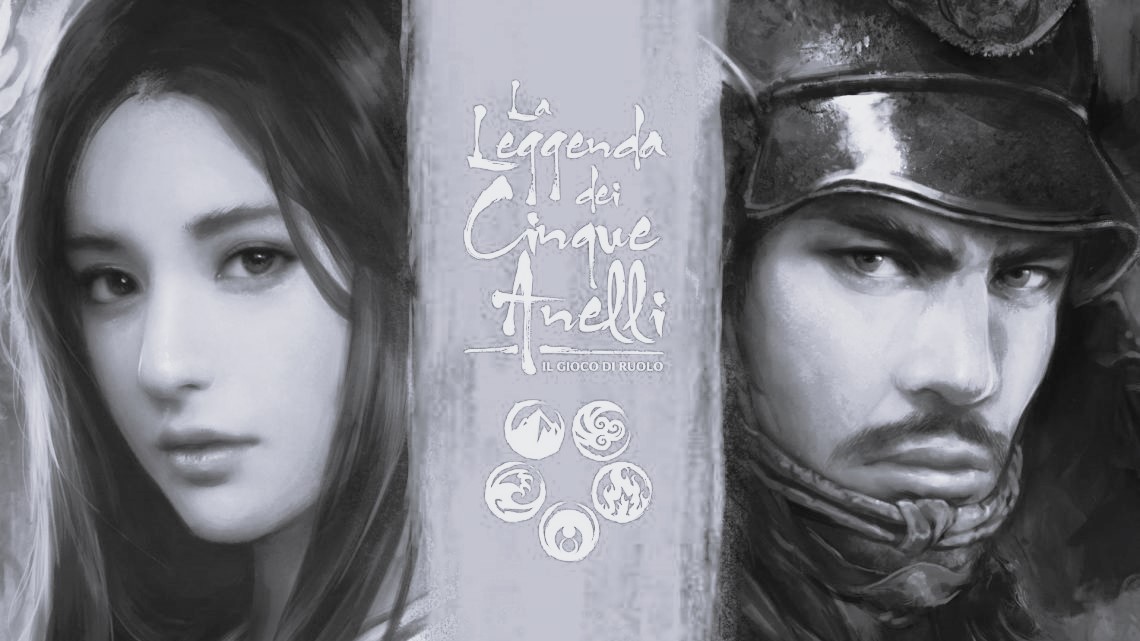
Legend of the Five Rings - The Roleplaying Game is an RPG published by Fantasy Flight Games and brought to Italy by Need Games!, letting you roleplay in a setting inspired by the Far East.
Rokugan, a fantasy world inspired by feudal Japan of the Sengoku Era, needs you, honourable samurai, to repel the threats spawned by corruption and restore harmony to society. You will be a warrior, a priest, a monk, a courtier or an artisan in the service of the Emerald Emperor, Hantei, and of one of the many clans of his court.
Remember: honour is everything!
We recently had the honour of trying Legend of the Five Rings in person for the first time. Now that we have completed our initiation ritual into the game, here are some extra details for those who want to try it after all the buzz!
In past years we also played a board game version based on the same Legend of the Five Rings setting. Those of you who already know it will find the roleplaying game easier to grasp.
Introduction to the game
In Rokugan — culturally influenced by medieval Japan and geographically by China — the descendants of the Kami and the great Clans rule over prosperous lands, nonetheless surrounded by the Shadowlands: places teeming with evil beings at the peak of corruption.
Seven great Clans keep order in this world. Players take the role of Samurai in a system that uses six- and twelve-sided dice.
Black six-sided dice:
Rolled according to the values tied to the rings — five in all, reflecting the five elements (air, earth, fire, water and void) — that is, the character’s own attributes. Skills are associated with each ring.
White twelve-sided dice:
Rolled to use the character’s skills. The combination of symbols on the rolled dice indicates the degree of success and additional information on the consequences of the roll.
N.B.: some rolls can leave characters unsettled. These are moments of ‘emotional compromise’ that enrich the game and the scenes of interaction between players. Every PC has honour and glory scores indicating how dishonourable or embarrassing the ‘unmasking’ was for that character.
What characters can you create?
Characters are defined by the clan and family they were born into, and by the schools or orders where they trained.
The most important caste is that of the noble samurai, played by the players, comprising:
-
the bushi (warriors);
-
the shugenja (priests);
-
the courtiers (politicians);
-
the artisans (in the sense of makers of works of art).
Next come the heimin (half-men): peasants, artisans (makers of everyday objects) and merchants.
At the lowest level are the hinin, the non-people — those who deal with dead matter (butchers, gravediggers, executioners, tanners), criminals, ninja and geisha.
The 7 Samurai clans serving the emperor are made up of many families:
-
The Crab Clan: watches over the Kaiu Wall, protecting Rokugan from the horrors of the Shadowlands.
-
The Crane Clan: the keeper of culture in Rokugan. It pursues perfection in every endeavour, and its samurai weave extensive social networks.
-
The Dragon Clan: the most philosophical of clans, whose strongholds rise in the mountains. Its ranks include many monks.
-
The Lion Clan: the highest expression of the honourable samurai warrior, who fears nothing and meets danger head-on.
-
The Phoenix Clan: the most spiritual clan in the entire Emerald Empire, blessed with a greater presence of priests.
-
The Scorpion Clan: the Emperor’s “hidden hand”. It represents those who dirty their hands — even renouncing their own honour — to protect the Emperor from internal enemies.
-
The Unicorn Clan: a clan of explorers, returned to the Empire after eight hundred years of wandering. It feels a stranger in its own home and struggles to adapt to Rokugan’s standards.
Every character has strengths and weaknesses. All PCs are marked by strong psychology and many inner conflicts. The whole game rests on the rituals of social life.
Challenges can be overcome in different ways, but the way characters overcome them affects the characters’ minds. Samurai have a strong sense of honour, duty and tradition, which varies with family, clan and school. How they react to their unsettled moments makes them grow in the game world — or throws them into crisis.
There are also many techniques that allow a character to accomplish extraordinary feats. The characters face many worldly intrigues and just as many supernatural ones, threatening the order of things.
Unlike another well-known RPG from the same publisher, 7th Sea, which lets you throw yourself into carefree swashbuckling adventure, this game leans more on the Eastern tradition of appearing in harmony — a fundamental component of a distant culture found, for instance, in the gestures used to perform an action such as pouring tea. To many Western players it may feel like roleplaying a somewhat introverted character, so to speak, extremely conscious of how others judge them by their appearance and conduct.
Leafing through the manual
Our first impression
The setting is certainly intriguing and unusual — ideal for those with more refined or Eastern-leaning tastes. Character interactions felt a bit more static than we are used to, but they gave us the chance to explore, as a group, aspects of the characters’ psyche that other games would leave aside.
Given the relatively slow pace of the adventure, we appreciated the master’s choice to divide it into ‘scenes’. This allowed the participants to focus on the most salient parts and skip the less relevant travel or filler sections, without getting bored.
The only difficulty we ran into was understanding the game system. At first it took a while to grasp the dice-rolling combinations and the correct interpretation of results, but we suppose that once players get into the habit, the mechanism flows much more smoothly and avoids spoiling the atmosphere.
For those interested in purchasing or in further information, we recommend the site below.